Biography

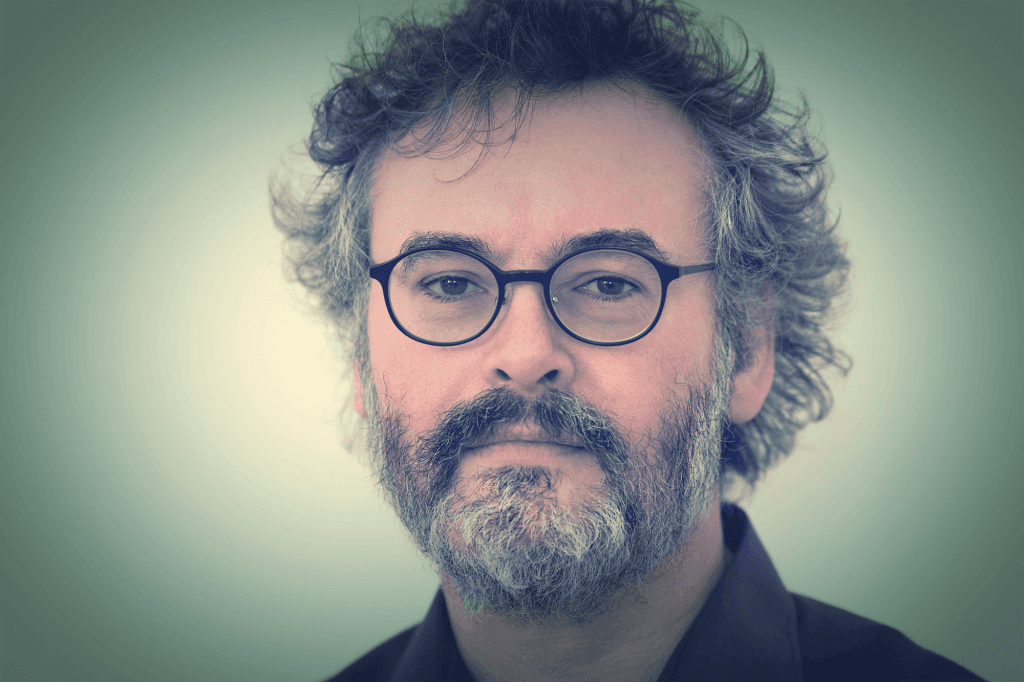
Luc De Winter
Luc De Winter (born 1966) was thirteen years old when, listening to Mussorgsky's Pictures at an Exhibition, he suddenly experienced how the boundary between himself and the music disappeared. He was the music. At that moment, there was no framework whatsoever to express this or even to approximate it. This early experience is undoubtedly linked to the fact that he would subsequently devote his life to music, Zen Buddhism and their mutual interaction.
He graduated from the Lemmens Institute in Leuven, where he studied organ, composition and music history, among other subjects. His most important teachers were Luk Bastiaens, Reitze Smits, Luc Van Hove and Yves Knockaert.
His interest in Zen Buddhism only really blossomed in 1992. In 1996, he began a thorough practice in the Soto Zen tradition. He received bodhisattva ordination in 1998 and monk ordination in 2003, and subsequently became a teacher at Ho Sen Dojo in Antwerp, where he leads meditation sessions, workshops and group discussions and offers personal guidance; each year he also leads four retreats. From his teacher, Master Patrick Pargnien (Bordeaux), he received the dharma transmission that officially made him a Zen master.
Luc always emphasises that the deepening and awakening (enlightenment) cultivated in (Zen) Buddhism are not limited to this tradition. They are part of our human nature, and we therefore find this mystical practice of transcending personal existence in Advaita Vedanta, Sufism, Christian mystics such as Meister Eckhart, and countless other teachers and traditions.
Virtually all of Luc De Winter's music is inspired by this universal, transcendent experience, this intimacy with existence. He therefore regards his work as an expression of this, and as an invitation to the same experience. In this sense, it is closely related to the Japanese shakuhachi tradition, Indian classical music, ancient Christian liturgical music such as Gregorian chant, medieval and Renaissance music, and the work of twentieth-century composers such as Olivier Messiaen, Morton Feldman, Giacinto Scelsi and Arvo Pärt.
Luc has written music for and on commission from various ensembles (Carré, Trio Aura, Ictus Ensemble, Ensemble Polyfoon, I Fiamminghi), soloists (Lucy Grauman, Paul De Clerq, Frederik Croene, Veerle Peeters, Isabel Alonso Morillo, Tristan Driessens, Osama Abdulrasol, Lily Moons, Erwin De Bock, Lieselot Watté, Katrien Mannaert, Annelies Focquaert, Annelies Brants) and for the flute & piano duo Linde Van den Berk and An Van Reeth. His music has been performed at festivals such as November Music, Grenzenloos, Klankdomein, De Gentse Feesten and the Festival Van Vlaanderen and has been broadcast by VRT radio, television and German Radio.
Since 2018, Luc has been living a secluded life due to chronic health problems. Coping with and accepting physical limitations has since become an essential part of his daily discipline.
Collaboration with Kazuaki Tanahashi
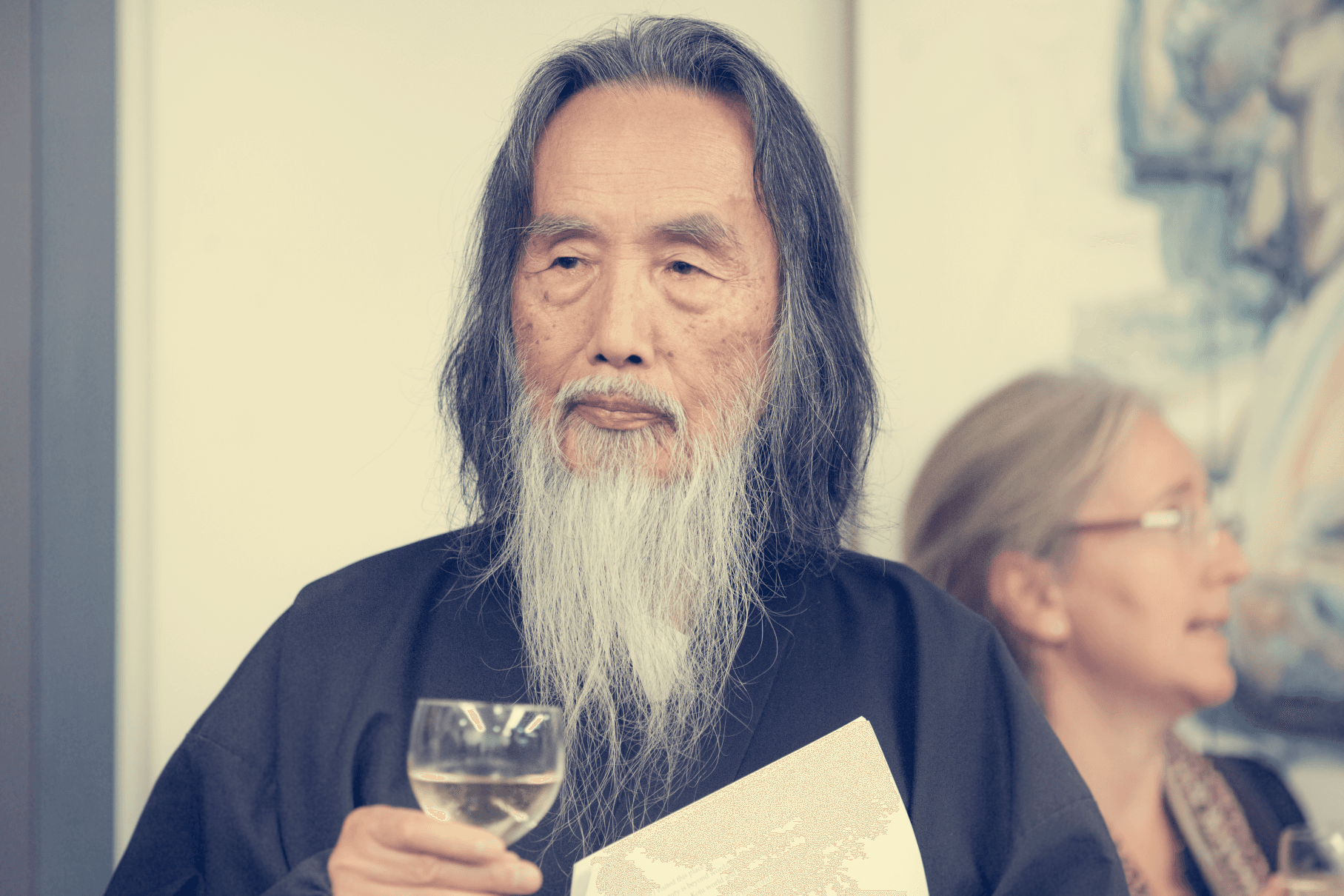
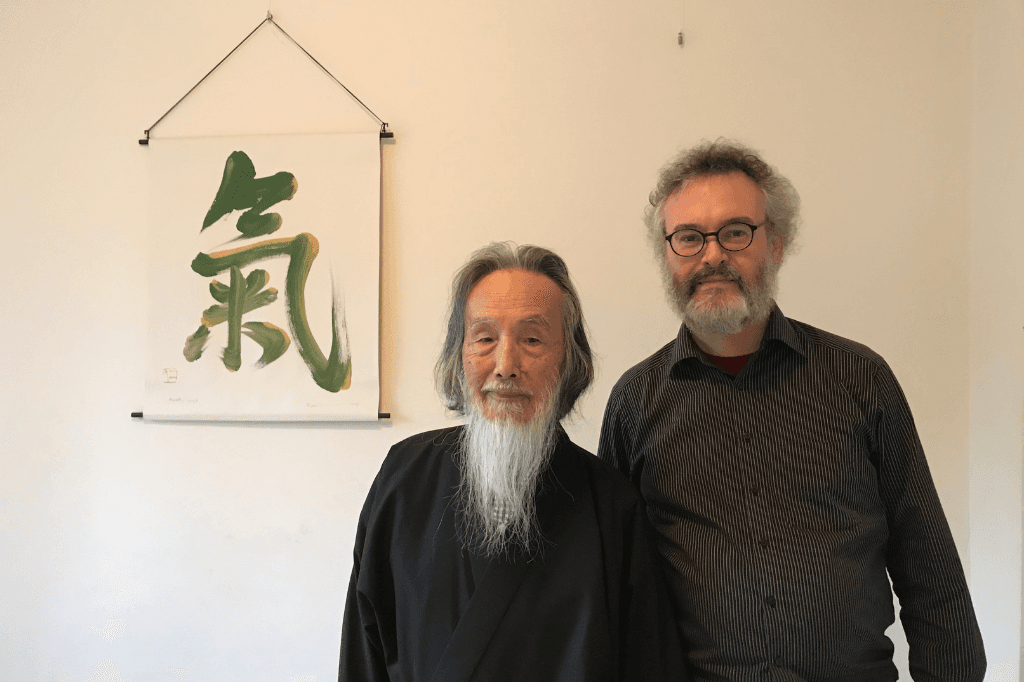
Since 2008, Luc has been collaborating with calligrapher, translator of classical Buddhist texts and peace and environmental activist Kazuaki Tanahashi (born 1933).
This collaboration led to the programme Sandokai - Zen & Polyphony (2010) , commissioned by Ensemble Polyfoon, which was responsible for four performances and a CD recording. The seven pieces for a cappella choir are settings of classical texts from Zen Buddhism, in a new translation by Tanahashi with the collaboration of renowned Zen teachers such as Joan Halifax (Santa Fe), Dan Leighton (Chicago) and David Schneider (Cologne).
A year later, Death Poem for mezzo and piano, based on a poem by Tanahashi, was performed.
Kaz created the cover for Luc's piano album Kannon's Pillow (2012); the design of this site is also based on this.
In 2013 Songs from Five Scoop Hut was created, a song cycle of an hour and a half based on poetry by the legendary Zen monk Ryokan, translated into English by Tanahashi. The performers were mezzo Els Mondelaers and pianist Veerle Peeters.
Tanahashi, De Winter and violinist Lily Moons organised a “calligraphic concert” at the Royal Academy of Fine Arts in Antwerp in October 2015. Calligraphy was performed during the performance of Chant & Chaconne for solo violin; at other moments, Lily and Kaz improvised music and calligraphy together.
In 2017, Kaz's peace organisation A Word Without Armies (Berkeley, CA) commissioned Luc to write Ten Millennium Future for organ. The work was first performed in 2018 by Annelies Focquaert; after each of the three movements, Tanahashi created a large calligraphy.
The song cycle for soprano and organ Cold Mountain is based on translations Tanahashi made with Zen master and poet Peter Levitt (British Columbia), this time of the poetry of Hanshan (China, 9th century). It was premiered by Annelies Focquaert and Annelies Brants in October 2019.

Aigo
AIGO - a ceremony for consort (second string quartet, lasting approximately one hour) was premiered by a viola da gamba quartet (Piet Stryckers, Piet Van Steenbergen, Lies Wyers & Pieter Vandeveire) in the Gothic Keizerskapel in Antwerp on November 11, 2011.
Piano music
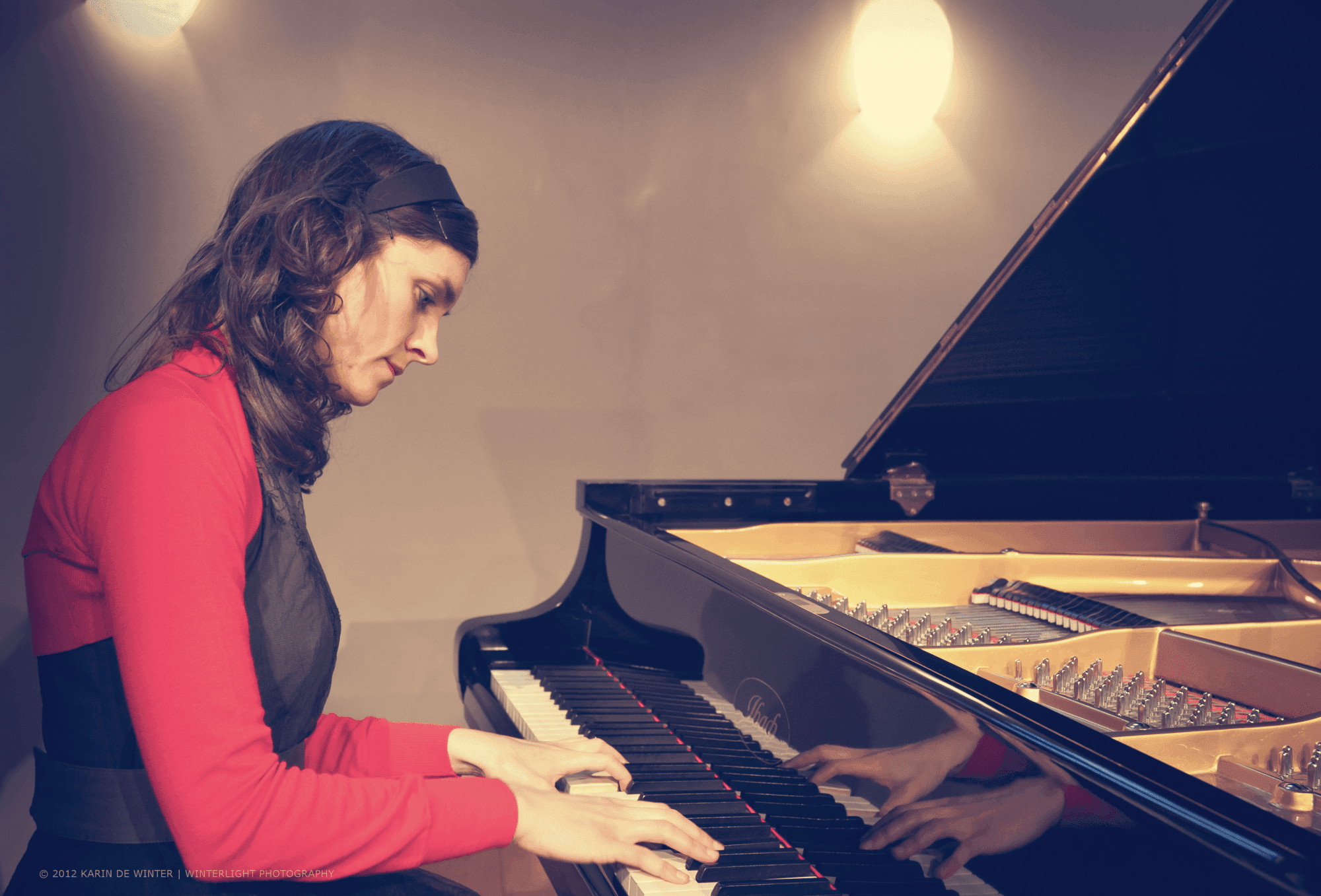
On 12 February 2012, Luc's piano album Kannon's Pillow , performed by Veerle Peeters, was presented to the public with a live concert. The seven pieces were written in 2000/2001 and 2010-2011. KLARA presented the CD in detail in an interview with the composer and kept the recording on its playlists for years.
Film director Konrad Maquestieau made a short film, The Regarder of Sounds , based on the Kannon's Pillow album; this film premiered at Cinéma Galeries, Brussels (December 2013); it was presented in October 2014 in Antwerp (Roma theatre) and in Amsterdam (EYE Film Museum).
Between 2012 and 2017, Luc wrote more than two and a half hours of piano music; the last piece, the seven-part cycle Book of Presence , was premiered by Erwin De Bock in 2017. Other works were performed by Veerle Peeters and An Van Reeth.
It was not until the end of 2025 that Luc returned to the piano to begin composing Urmayah opus 78.